

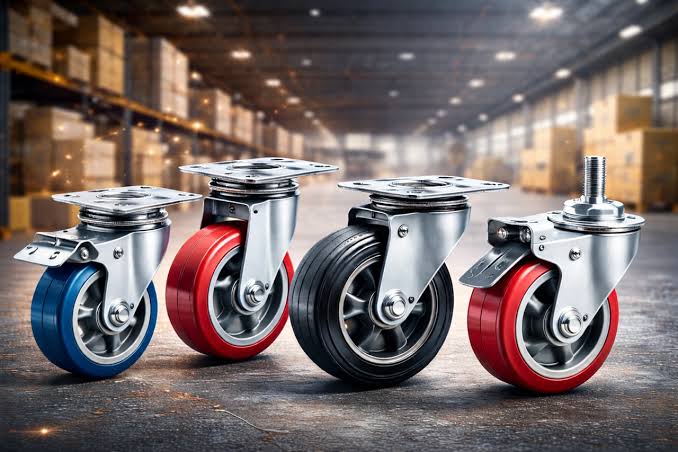
Complete Guide to Choosing Heavy-Duty Castor Wheels for Industrial and Commercial Use in Kenya
Welcome to Part 3: Castor Wheels! From busy logistics warehouses along Mombasa Road and Industrial Area in Nairobi to hospitals, supermarkets, bakeries, hotels, and manufacturing plants across Mombasa, Kisumu, and Eldoret, heavy-duty castor wheels keep businesses moving. Although small compared to the machinery, platform trolleys, and storage racks they support, choosing the wrong castor wheel leads to cracked concrete or tiled floors, jammed bearings, bent forks, and frustrating workplace bottlenecks.
Selecting the right heavy-duty castor wheel comes down to balancing five core factors: load capacity, wheel tread material, wheel diameter, swivel vs. rigid configuration, and operating environment. Understanding how each specification works ensures smooth, quiet, and safe material handling across your facility.
1. Calculate the True Load Capacity (And Build in a Safety Margin)
The most common mistake facility managers make when buying replacement wheels is dividing the total trolley weight evenly across four castors. On real warehouse floors—which inevitably have expansion joints, ramps, thresholds, or uneven cabro paving—all four wheels rarely touch the ground simultaneously. At any moment, three wheels may carry the entire load.
The Industry Safety Formula
- Example: If a steel platform trolley weighs 60 kg and carries 540 kg of stock, the total weight is 600 kg. Dividing by 3 means each castor must be rated for at least 200 kg.
- Shock-Load Buffer: If heavy pallets or crates are dropped onto the trolley from a forklift or loading dock, add an extra 25% to 30% safety margin so sudden impact forces do not bend the swivel raceway or crush the wheel core.
2. Match Wheel Tread Material to Your Floor Surface
Different wheel materials behave very differently on epoxy-coated warehouse floors, ceramic hospital tiles, rough asphalt, or wet cold-storage rooms.
Polyurethane (PU) Castors — The All-Round Commercial Favorite
Polyurethane tyres bonded onto cast iron, aluminium, or nylon cores combine the best traits of rubber and hard plastic.
- Best For: Epoxy warehouse floors, supermarket aisles, hospital corridors, and manufacturing plants.
- Advantages: High load capacity (typically 200 kg to 900+ kg per wheel depending on diameter and core), non-marking on tiles, quiet rolling, shock-absorbing, and resistant to oils, grease, and industrial chemicals.
Nylon & Polypropylene Castors — High Load, Low Rolling Resistance
Hard white or black engineered nylon wheels glide effortlessly under heavy loads on smooth, flat surfaces.
- Best For: Food processing plants, cold rooms, bakeries, wet washdown areas, and smooth concrete floors.
- Advantages: Extremely low rolling resistance (making heavy carts easy to push manually), high load ratings (150 kg to 1,200 kg per wheel), waterproof, rust-proof, and resistant to most solvents and cleaning acids.
- Watch Out: Hard nylon wheels can be noisy on rough concrete and may scratch delicate polished tiles.
Industrial Rubber & Pneumatic Castors — Outdoor & Fragile Cargo
Elastic rubber tyres (solid or air-filled pneumatic) cushion vibrations over rough surfaces.
- Best For: Outdoor cabro driveways, gravel yards, uneven loading docks, and trolleys carrying fragile glass, electronics, or medical equipment.
- Advantages: Superior shock absorption, quiet operation, and strong grip on wet surfaces. Grey thermoplastic rubber (TPR) options also prevent black scuff marks on indoor floors.
Cast Iron & Forged Steel Castors — Extreme Heavy Industry
Built for brute strength where load weights exceed standard polymer limits.
- Best For: Heavy machinery bases, welding workshops, foundries, and high-temperature ovens.
- Advantages: Massive load capacities (500 kg to 3,000+ kg per wheel) and extreme heat resistance.
- Watch Out: Will chip or groove tiled and epoxy floors if overloaded; best used on thick reinforced industrial concrete or steel tracks.
3. Quick Comparison: Wheel Materials at a Glance
| Wheel Material | Typical Load Range (Per Wheel) | Floor Protection | Noise Level | Best Operating Environment |
| Polyurethane (PU) | 200 – 900+ kg | Excellent (non-marking) | Quiet | Warehouses, epoxy floors, hospitals, retail |
| Heavy-Duty Nylon | 150 – 1,200 kg | Moderate (hard tread) | Moderate | Smooth concrete, food/dairy plants, wet areas |
| Elastic / TPR Rubber | 70 – 450 kg | Excellent | Very Quiet | Outdoor cabro, ramps, fragile goods, hotels |
| Cast Iron / Steel | 500 – 3,000+ kg | Low (hard on tiles) | Loud | Heavy engineering workshops, machinery bases |
4. Choose the Right Wheel Diameter and Bearing Type
- Wheel Diameter: Larger wheels roll much more easily over floor cracks, cabro joints, and door thresholds because they have a gentler angle of attack.
- 75mm – 100mm (3″–4″): Light-to-medium office carts, display racks, and compact shop trolleys.
- 125mm – 150mm (5″–6″): Standard warehouse platform trolleys, hospital beds, and commercial kitchen racks.
- 200mm – 250mm+ (8″–10″+): Heavy-duty industrial carts, outdoor yard trolleys, and heavy machinery moving over rough floors.
- Bearing Selection:
- Plain Bore: Simple, affordable, and unaffected by water washdowns—ideal for wet food environments and light loads.
- Roller Bearings: Handle high radial loads efficiently on standard warehouse trolleys.
- Precision Sealed Ball Bearings: Offer the smoothest, lowest-effort push under heavy loads while keeping dust, threads, and moisture out of the hub.
5. Swivel vs. Rigid (Fixed) Castor Layouts and Brakes
How you arrange swivel and rigid forks determines how easy your trolley is to steer:
- 2 Swivel + 2 Rigid (Fixed): The gold standard for straight-line warehouse trolleys and long corridors. Rigid castors at the rear keep the trolley tracking straight, while swivel castors at the front allow tight turns.
- 4 Swivel Castors: Ideal in tight hospital rooms, retail aisles, or workshops where trolleys must move sideways or spin 360° on the spot.
- Total-Lock Brakes: Essential on slopes, loading docks, workbenches, and medical equipment—locking both the wheel rotation and the swivel head simultaneously so the unit cannot drift.

Related Posts

5 Best German Children’s Entertainers in Julian – Find puppet shows, music, and games that delight kids

5 Best German Ice Skating Rinks in Ouray – Find open skate sessions and winter fun